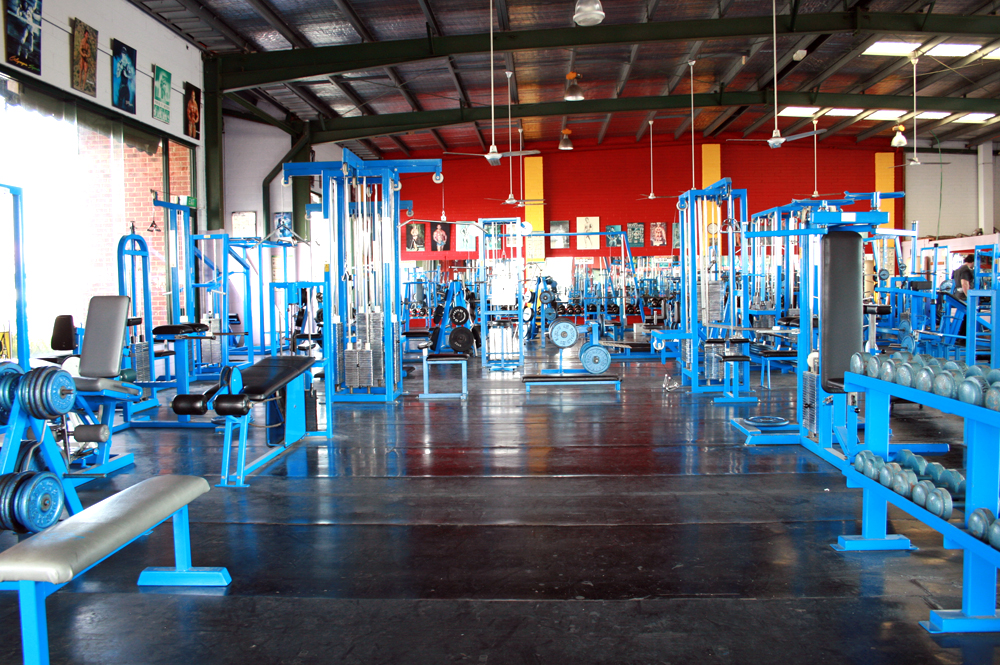
Fitness centers can create both airborne noise and structure-borne vibration that may be transmitted into adjacent or vertically separated residential spaces.
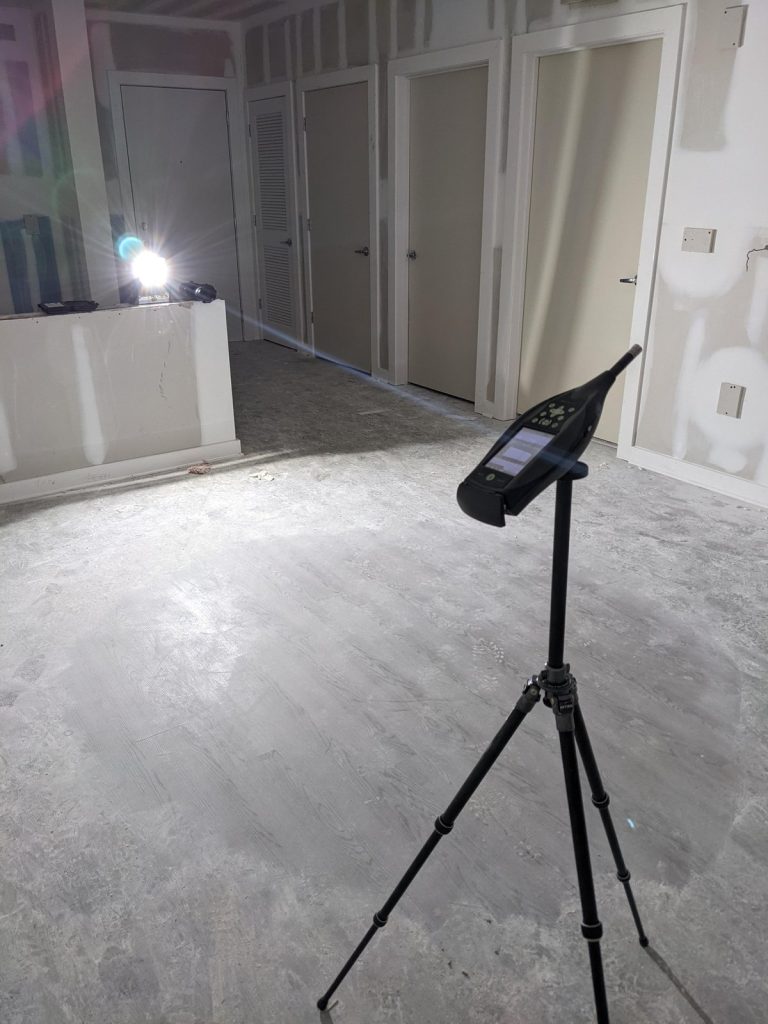
On-Site Acoustic Testing provides field measurements for condominium, apartment, hotel, mixed-use, and other buildings where exercise equipment, free weights, group fitness activity, or building systems are generating noise or vibration concerns.
Fitness Center Noise and Vibration Sources
Common sources include treadmills, stationary bikes, ellipticals, rowing machines, selectorized equipment, free weights, weight stacks, dropped weights, group exercise activity, loudspeakers, HVAC systems, and mechanical equipment serving the fitness area.
Field Measurement and Source Identification
Testing can include airborne sound levels, one-third-octave or spectral analysis, vibration measurements, event-based measurements, and source-by-source operating comparisons. Where several pieces of equipment are present, testing can help identify which sources or operating conditions are responsible for the dominant transmission.
Structure-Borne Vibration
Exercise equipment can transmit energy directly into the floor structure, particularly when treadmills, weight equipment, or impact-producing activities are located above or adjacent to noise-sensitive spaces. Field vibration measurements can document the transmitted response and provide a baseline for evaluating isolation measures.
Mitigation and Before-and-After Testing
Where corrective work is proposed, measurements can be used to compare equipment locations, resilient pads, isolation systems, flooring assemblies, operational changes, or other mitigation measures. Follow-up testing can document the change in measured conditions.
Long-Term and Remote Monitoring
For intermittent or schedule-dependent conditions, long-term and remote noise and vibration monitoring can document events over days, weeks, months, or longer periods. Monitoring can be correlated with operating schedules or complaints, and synchronized sound and video recording can be used where appropriate to document events and site conditions.
Independent Field Documentation
OSAT does not sell fitness equipment, flooring, or vibration-isolation products. Our role is to provide independent measurements, technical interpretation, and documentation that can support troubleshooting, design decisions, dispute resolution, or verification of corrective work.
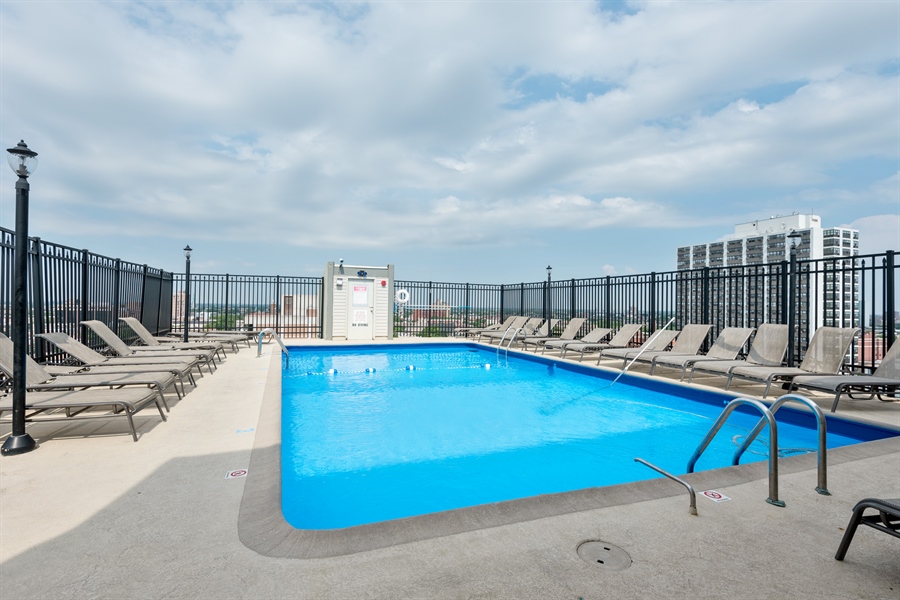
Swimming pools, spas, pumps, filtration systems, mechanical equipment, and associated activities can create both airborne noise and structure-borne vibration in residential and mixed-use buildings.
On-Site Acoustic Testing provides field measurements for existing complaints, design review, troubleshooting, and verification of corrective work involving pool and spa facilities.
Pool and Spa Noise Sources
Potential sources include pumps, motors, filtration equipment, water features, heaters, ventilation equipment, rooftop or equipment-room systems, and normal pool activity. Measurements can distinguish continuous mechanical noise from intermittent activity-related events.
Noise and Vibration Measurement
Testing can include A-weighted and C-weighted sound levels, octave or one-third-octave analysis, narrowband or FFT analysis where useful, and vibration measurements at floors, walls, equipment supports, and other relevant locations.
Mechanical and Structure-Borne Transmission
Pumps and other rotating equipment can transmit vibration through rigid piping, equipment bases, slabs, walls, and framing. Field measurements can help identify dominant transmission paths and establish a baseline for evaluating isolation or operational changes.
Outdoor and Community Noise
For outdoor pools and amenity areas, measurements can be performed at property lines, façades, balconies, patios, or other receiver locations. Testing can document operating and non-operating conditions, daytime or nighttime conditions, and the contribution of specific equipment or activities.
Long-Term Monitoring
Where the condition is intermittent or varies with occupancy and operating schedules, long-term and remote monitoring can document noise or vibration over days, weeks, months, or longer periods. Optional synchronized sound and video recording can be used where appropriate to document events and site conditions.
Mitigation Verification
Before-and-after measurements can document the effectiveness of equipment isolation, piping changes, enclosures, barriers, operational adjustments, or other corrective work.
On-Site Acoustic Testing provides independent field measurement and technical consulting for condominium associations, homeowner associations, apartment managers, property managers, and multifamily building owners.
Our role is to provide objective data where noise, vibration, sound isolation, mechanical equipment, flooring, amenity spaces, or other environmental conditions are affecting residents or creating disputes.
Long-term and remote noise and vibration monitoring can document intermittent or recurring conditions over days, weeks, months, or longer periods. Logged measurements can be correlated with resident complaints, operating schedules, construction activity, or other events. Optional synchronized sound and video recording can be used where appropriate.
Independent Documentation for Decisions and Disputes
Measurements can support board decisions, management actions, design and remediation work, contractor verification, dispute resolution, and development of objective building standards. OSAT does not sell acoustical products, flooring, or installation services.
Additional Field Services
Projects can also involve indoor air quality, infrared thermography, elevator or building-system investigations, and other specialized field measurements where objective documentation is needed.
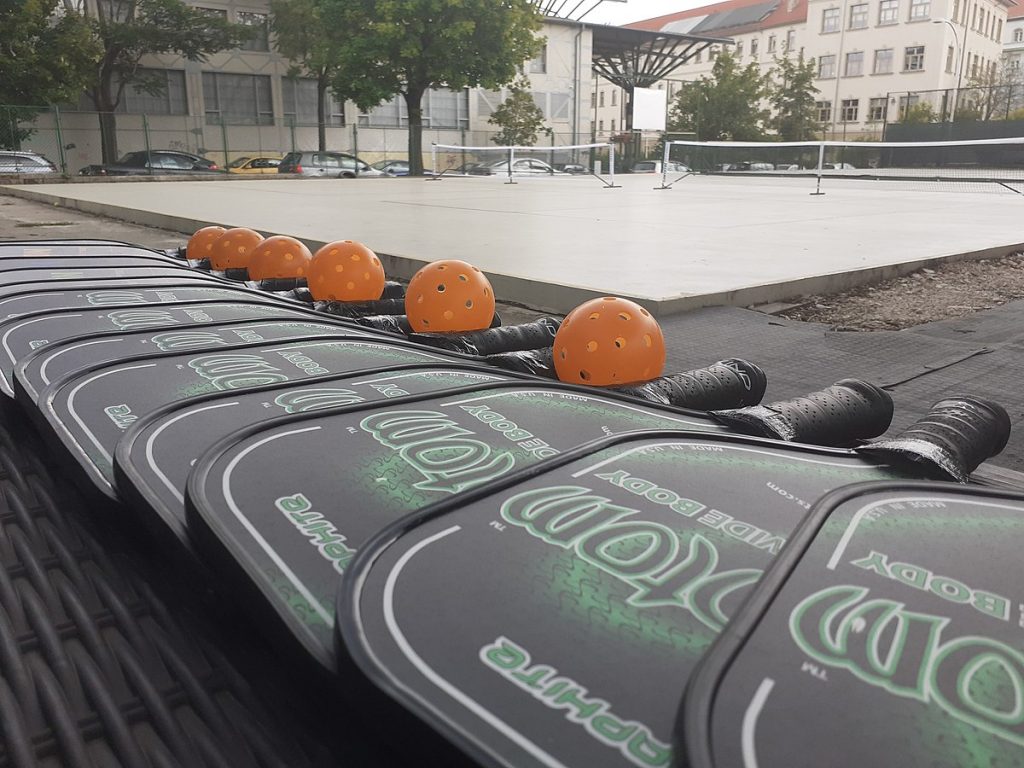
On-Site Acoustic Testing provides independent pickleball noise measurement and consulting for condominium associations, homeowner associations, apartment communities, developers, municipalities, property owners, and neighbors affected by existing or proposed courts.
Existing pickleball court noise
Pickleball impacts can be distinctive because the paddle-and-ball impulse is brief, repetitive, and often substantially more noticeable than the overall average sound level would suggest. Field measurements can document court activity at nearby residences, property lines, balconies, outdoor amenity areas, and other affected locations.
Attended court-noise measurements
Property-line and residential receiver measurements
Time-history and maximum-level review
Frequency-content and tonal-character assessment where useful
Comparison of active and inactive court conditions
Long-term monitoring for representative operating periods
Proposed courts and site planning
For planned or relocated courts, OSAT can review the proposed relationship between the courts and nearby receivers, establish existing ambient conditions, and provide measurement-based input for siting and mitigation decisions. Actual project requirements should be evaluated against the applicable local criteria and site conditions.
Long-term and remote monitoring
Where play varies by day or time, long-term and remote monitoring can document court use over days, weeks, months, or longer. Optional sound and video recording can be incorporated where appropriate to help correlate measured events with actual site activity.
Mitigation verification
Measurements can also be performed before and after barriers, operational changes, court modifications, or other mitigation measures to determine the actual change at affected receiver locations.
Independent field assessment
OSAT does not sell barriers, acoustic products, or installation services. Our role is to measure the field condition objectively and provide technically defensible documentation for boards, managers, owners, designers, municipalities, and affected residents.
Dedicated pickleball noise resources
For a broader explanation of pickleball noise, its effects on nearby neighborhoods, approaches to measurement, and potential mitigation strategies, visit PickleballNoise.com, a specialized educational and acoustical consulting resource operated by On-Site Acoustic Testing.
On-Site Acoustic Testing provides independent field measurement, verification, and troubleshooting for acoustics, noise, vibration, RF shielding, secure facilities, thermal conditions, and related environmental parameters.
OSAT supports data center, HVAC, generator, pump, fan, cooling-system, and other mechanical investigations involving noise, vibration, source localization, commissioning support, and FLIR thermal imaging.
OSAT performs field work throughout the United States and internationally. Testing programs are developed around the applicable project specification, standard, acceptance criterion, or technical question.
Field testing of installed building assemblies for airborne sound isolation, impact sound isolation, exterior façade performance and reverberation.
On-Site Acoustic Testing provides building acoustics field testing throughout the United States and internationally for government and military facilities, architects, engineers, contractors, developers, building owners and property managers. Testing is performed using applicable ASTM and ISO procedures with dedicated building-acoustics instrumentation.
Method selection matters: ASTM E336, E1007 and E966 are related to—but not automatically equivalent to—the ISO 16283 field series and its DIN EN ISO adoptions. See the Acoustic Standards Directory for current references, rating companions and edition-verification notes.
Building Acoustics Field Testing
Building-acoustics testing evaluates the performance of the completed, installed construction rather than relying only on laboratory ratings or design assumptions. Field results reflect the actual walls, floors, ceilings, doors, façades, penetrations, junctions and flanking paths present at the project site.
What We Test
Demising walls and partitions between rooms, units and occupancies
Floor/ceiling assemblies for airborne and impact sound isolation
Doors, frames, seals, glazing and other openings
Exterior walls, windows, doors and façade systems
Rooms where reverberation and sound decay affect speech, music or usability
Completed assemblies that have failed a specification, generated complaints or require acceptance testing
Field measurements can be used to verify completed construction, document compliance with project criteria, investigate sound-isolation problems and identify assemblies or transmission paths requiring corrective work. OSAT provides testing for commercial, residential, institutional, government and secure-facility projects.
ASTM E336 field measurement of airborne sound isolation across installed walls, floor/ceiling assemblies and other separating partitions. ASTC and related field metrics include the effects of the installed construction and flanking transmission.
ASTM E1007 field measurement of impact sound transmission through installed floor/ceiling assemblies using a standardized tapping machine. AIIC testing is commonly used for multifamily residential construction, flooring evaluations and investigations of impact-noise complaints.
ASTM E966 field testing characterizes outdoor-to-indoor sound attenuation of installed exterior walls, windows, doors and façade systems. Depending on the measurement method and field conditions, results can be used to develop OITC/FOITC, AOITC or OINIC ratings.
Reverberation Time (RT)
Reverberation-time measurements characterize sound decay within an enclosed space. RT measurements are used as part of several building-acoustics field procedures and can also be performed independently to evaluate room acoustics for speech, music and other uses.
How Field Testing Is Performed
The test setup depends on the assembly and the applicable method. In a typical sound-isolation test, calibrated source and receiving-room measurements are made at multiple microphone positions, background noise and room conditions are documented, and the data are reduced to the required field rating. Impact testing uses a standardized tapping machine on the floor assembly, while façade testing uses exterior and interior measurements appropriate to the selected method.
Where the purpose is troubleshooting rather than simple acceptance, OSAT can vary source position, inspect likely leakage locations, compare adjacent assemblies, and test suspected flanking or bypass paths to determine why the installed result differs from the expected performance.
Current Building Acoustics Instrumentation
OSAT maintains dedicated field equipment including precision acoustic analyzers, standardized tapping machines and omnidirectional sound sources. Battery-powered instrumentation also allows measurements in locations where normal power or conventional access is impractical.
Troubleshooting, Remediation and Retesting
When an assembly does not meet its required performance, the numerical rating alone is only part of the answer. OSAT can help identify likely leakage, flanking, sealing, fitment or construction issues and provide measurement-based feedback while corrective work is being developed. After repairs are completed, the same assembly can be retested to verify the result.
Our building-acoustics work includes U.S. military and federal facilities, secure facilities, commercial and industrial buildings, multifamily housing, condominiums and other projects where installed acoustic performance must be measured objectively in the field.
What Clients Receive
Depending on the assignment, deliverables can include the applicable field ratings, frequency-by-frequency results, test locations and assembly descriptions, measurement conditions, photographs and field observations, comparison with project criteria, and identification of likely deficiencies or transmission paths. Retesting results can be documented alongside the original measurements to show the effect of corrective work.
Laboratory Ratings Versus Installed Building Performance
Laboratory STC and IIC values describe assemblies tested under controlled conditions; installed buildings can behave differently because of flanking paths, penetrations, construction details and workmanship. OSAT uses applicable field procedures, including ASTM E336 for airborne sound isolation and ASTM E1007 for impact sound measurements, with ratings calculated under the relevant classification standards. See our full field testing services for related measurement programs.
Discuss Your Building Acoustics Testing Requirements
Contact On-Site Acoustic Testing to discuss the building assembly, project criteria, site conditions and field measurement required.
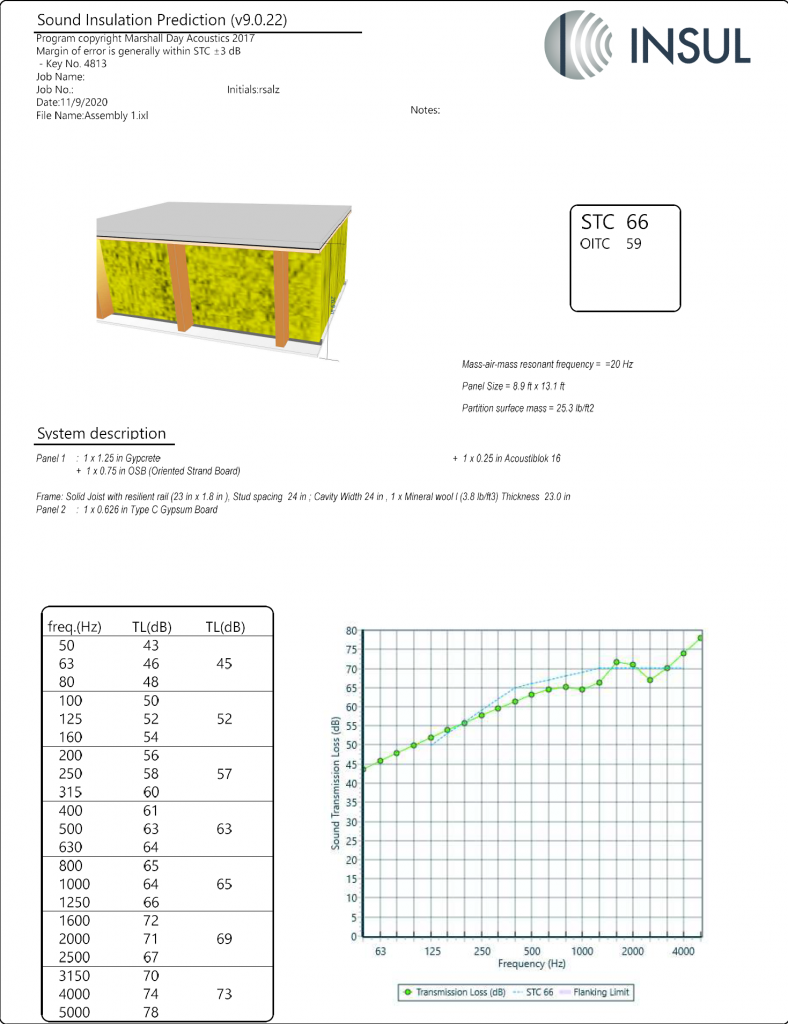
Acoustic modeling can help evaluate expected sound-isolation performance, compare construction alternatives and develop practical remediation strategies before field work begins.
On-Site Acoustic Testing provides modeling and technical evaluation of walls, floor/ceiling assemblies, windows and other building elements for projects involving airborne sound isolation, impact sound and acoustical security.
Modeling Building Assemblies
Modeling can be used to compare proposed assemblies, evaluate changes in materials or construction, and investigate existing assemblies that are not achieving the required acoustic performance. Depending on the project, the analysis may consider partitions, floors, ceilings, glazing and relevant transmission paths associated with building services.
Design, Troubleshooting and Remediation
For new construction, modeling can support acoustical plan review and comparison of design alternatives. For existing construction, it can help identify practical modifications to improve sound isolation and guide field investigation or remediation.
Modeling and Field Testing
Modeled performance and laboratory ratings should not be treated as substitutes for measurements of the completed building. Where verification is required, OSAT can perform building-acoustics field testing to document the performance of the installed construction.
Discuss Your Assembly or Remediation Problem
Contact On-Site Acoustic Testing with available drawings, assembly details, project criteria and any existing field or laboratory test data.
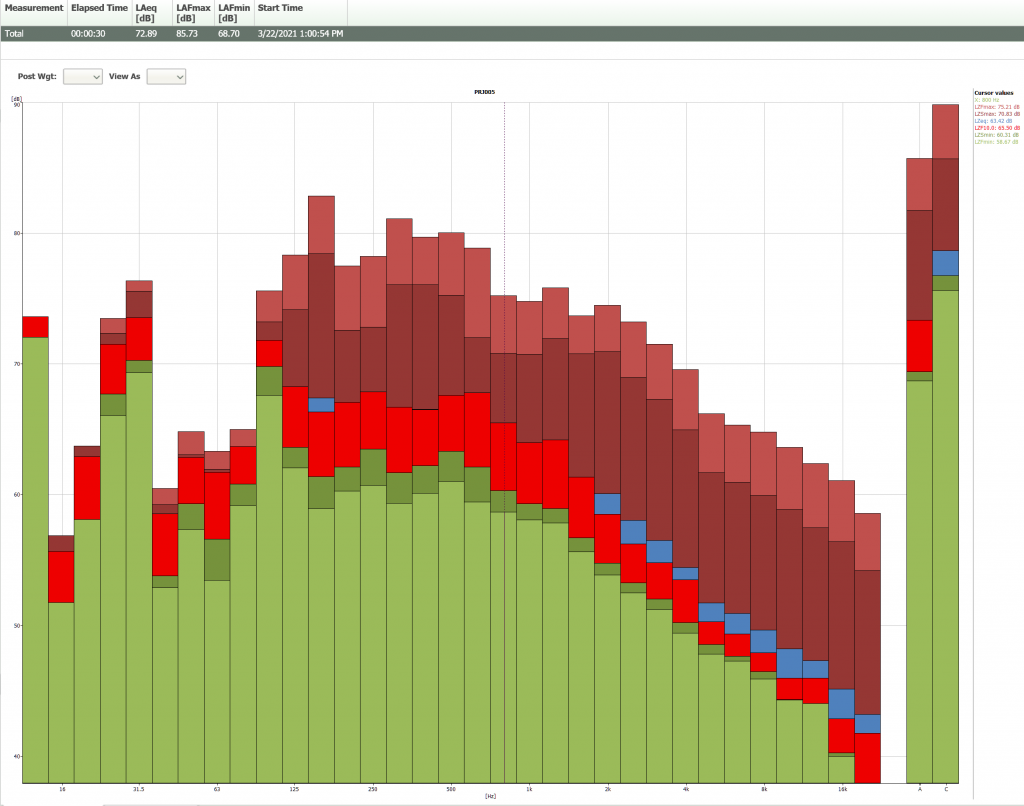
Frequency-spectrum analysis provides information that an overall sound-level measurement alone cannot show.
On-Site Acoustic Testing uses frequency analysis to characterize noise sources, identify dominant frequency components, investigate tonal or low-frequency problems, and support noise-control and troubleshooting work.
Octave-Band and One-Third-Octave Analysis
Sound can be analyzed by frequency band to show how acoustic energy is distributed across the spectrum. One-octave and one-third-octave measurements are widely used in building acoustics, environmental and industrial noise investigations, mechanical-system troubleshooting and evaluation of noise-control measures.
FFT and Narrowband Analysis
Where greater frequency resolution is useful, FFT or other narrowband analysis can help identify tones, harmonics and frequency components associated with particular machinery or processes. Comparing spectra under different operating conditions can also help distinguish competing sources.
Applications
Industrial and machinery noise investigations
HVAC and mechanical-system noise
Low-frequency and tonal noise complaints
Building and room acoustics
Source identification and troubleshooting
Pre- and post-mitigation comparisons
Specialized Source Measurements
Spectrum analysis can be combined with directional measurements and source-localization techniques when conventional sound-level measurements cannot adequately separate individual contributors. See our specialized noise testing and source localization services.
Discuss a Frequency-Analysis Project
Contact On-Site Acoustic Testing with the type of source, operating conditions and the noise or vibration problem being investigated so the appropriate measurement and analysis method can be selected.
Infrared thermography provides a non-contact view of surface-temperature patterns that can support building-envelope, mechanical, electrical, equipment, process, and diagnostic investigations.
On-Site Acoustic Testing uses FLIR thermal imaging as a field-investigation tool where temperature distribution, thermal anomalies, or changes under different operating conditions may help identify a problem or document performance.
FLIR Thermal Imaging and Surface-Temperature Mapping
Thermal images can show temperature patterns that are difficult to identify with conventional visual inspection alone. Depending on the project, OSAT can document surface-temperature differences, anomalous hot or cold areas, equipment operating patterns, and changes observed before and after corrective work.
Mechanical, HVAC, and Equipment Investigations
Thermography can be useful when investigating HVAC systems, air handlers, pumps, fans, motors, piping, rooftop equipment, generators, cooling equipment, and other accessible machinery or process surfaces. Thermal patterns can be compared between components or operating conditions to help identify areas that warrant additional investigation.
Building Envelope and Construction Investigations
Thermal imaging can identify temperature anomalies at walls, ceilings, windows, doors, penetrations, and other envelope or construction elements. These patterns may be associated with insulation discontinuities, air movement, thermal bridging, moisture-related conditions, or other construction differences, although interpretation depends on site conditions and should be correlated with other observations or measurements as appropriate.
Electrical and Accessible Equipment Surfaces
Infrared imaging can document unusual temperature patterns at accessible electrical panels, connections, and equipment surfaces without physical contact. OSAT uses thermography as a screening and documentation tool rather than as a substitute for electrical inspection, electrical safety evaluation, or trade-specific diagnostic work.
Data Center Thermal Investigations
For data centers and other mission-critical facilities, FLIR imaging can supplement noise and vibration work by documenting surface-temperature patterns at cooling equipment, air-handling systems, electrical and mechanical equipment, and other accessible infrastructure. Testing can include operating-condition comparisons, anomalous hot or cold areas, and before-and-after documentation associated with troubleshooting or corrective work.
Before-and-After and Comparative Testing
Where conditions can be reproduced, thermal images can be collected before and after repairs, adjustments, mitigation, or operating changes. Comparative imaging can provide a useful visual record of how surface-temperature patterns changed under the documented conditions.
Thermography as Part of a Broader Investigation
Infrared thermography does not directly measure sound leakage, vibration, electrical integrity, airflow, or moisture. It is most useful when thermal observations are interpreted alongside the appropriate field measurements and site information. For acoustic investigations, thermal imaging can provide supplementary information about construction discontinuities, while sound leakage itself should be confirmed using appropriate acoustic measurement or source-localization methods.
Independent Field Documentation
Reports can incorporate selected thermal images, visible-light photographs where useful, measurement conditions, observed temperature patterns, and technical interpretation appropriate to the scope of the investigation.
FLIR E8 Field Equipment
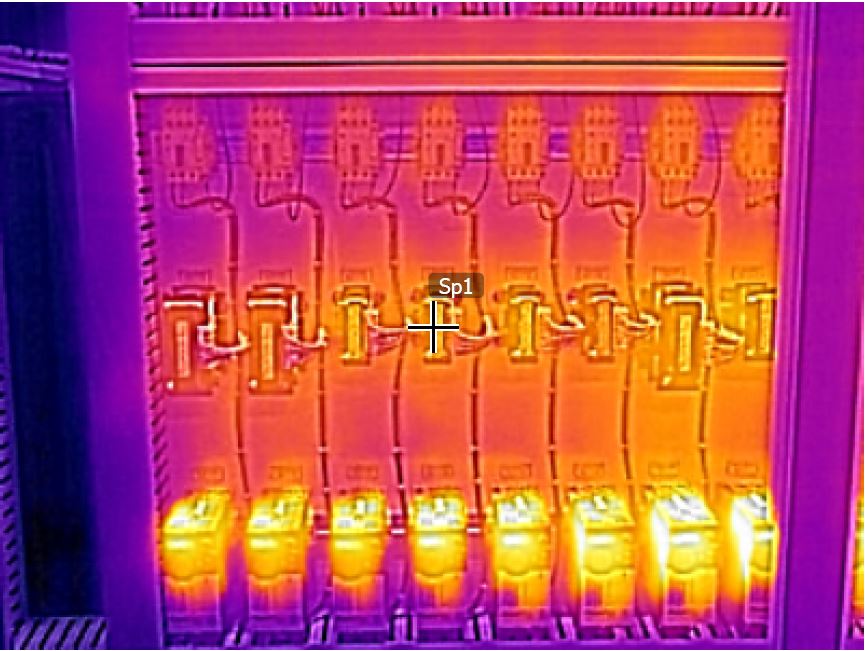
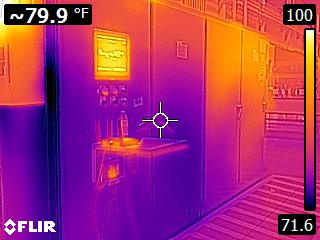
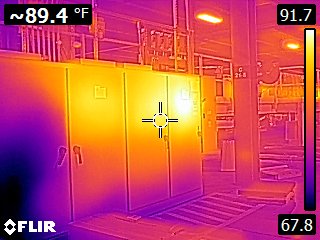
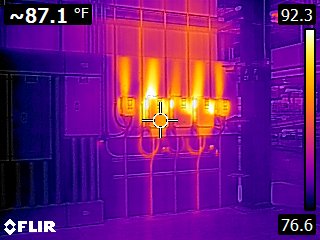
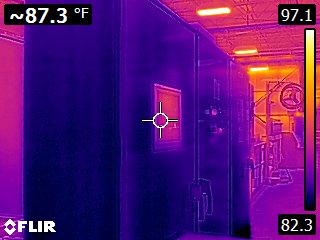
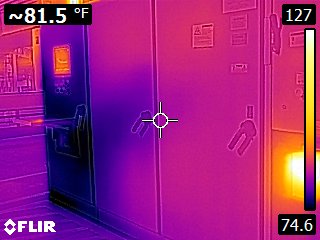
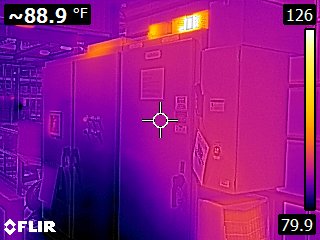
OSAT maintains FLIR E8 thermal imaging cameras for field investigations. These instruments help document relative temperature differences and conditions at the time of inspection. The following selected thermal images were captured using OSAT’s FLIR E8 equipment.
Selected FLIR Thermal Images
Examples from OSAT’s existing FLIR image archive. The colors show the selected display palette and relative thermal patterns; interpretation requires appropriate measurement settings and site context.
Measurement Conditions and Limitations
Thermal imaging measures emitted infrared radiation and estimates apparent surface temperature. Meaningful quantitative interpretation depends on emissivity, reflected apparent temperature, distance, viewing angle, environmental conditions, and instrument settings. A thermal anomaly is a diagnostic indication, not by itself proof of an electrical defect, moisture intrusion, or structural failure. Where a conclusion requires it, findings should be checked against additional observations, instruments, or specialist inspection.
For electrical work, inspections must be arranged with appropriate facility access, operating conditions, and qualified electrical personnel where required. OSAT’s thermography service is not a substitute for electrical safety assessment, code inspection, or a certified building energy audit unless expressly included in the agreed scope.
Integrated Investigations
Thermography can be combined with sound-level, sound-intensity, and vibration measurements when a facility has multiple interacting issues. For investigations involving mechanical source localization or other diagnostic methods, see Specialized Noise Testing and Source Localization. For cooling systems, equipment rooms, and facility operations, see Data Center Noise, Vibration & Thermal Testing.
What Clients Receive
Depending on the assignment, OSAT’s documentation may include representative thermal images, measurement locations, equipment and operating conditions, apparent temperature observations, image annotations, comparison of locations or operating states, and recommendations for further investigation where findings are inconclusive.
Discuss a Thermographic Investigation
Provide the building or equipment type, suspected condition, operating state, project location, and intended use of the results.
Field measurement of illuminance and lighting conditions for workplaces, commercial buildings, industrial facilities and other occupied spaces.
On-Site Acoustic Testing performs light-level surveys to document existing illumination, investigate complaints or deficiencies, compare lighting conditions across a facility, and verify project or client criteria. Measurements can be reported in lux or foot-candles as appropriate.
Illuminance and Light-Level Surveys
A lighting survey can document illumination at work surfaces, circulation areas, production spaces, offices, mechanical rooms, parking areas and other locations. Rather than applying a generic light-level table to every facility, OSAT can compare measured conditions with the criteria actually applicable to the space, task, project specification or governing requirement.
Professional Light Measurement Equipment
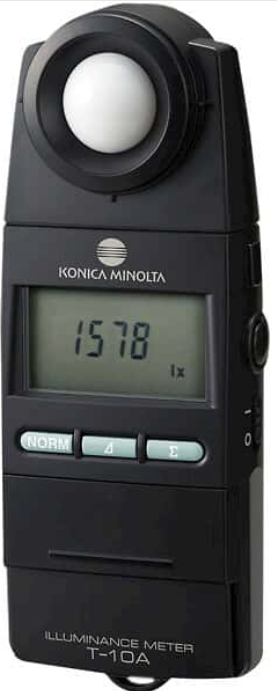
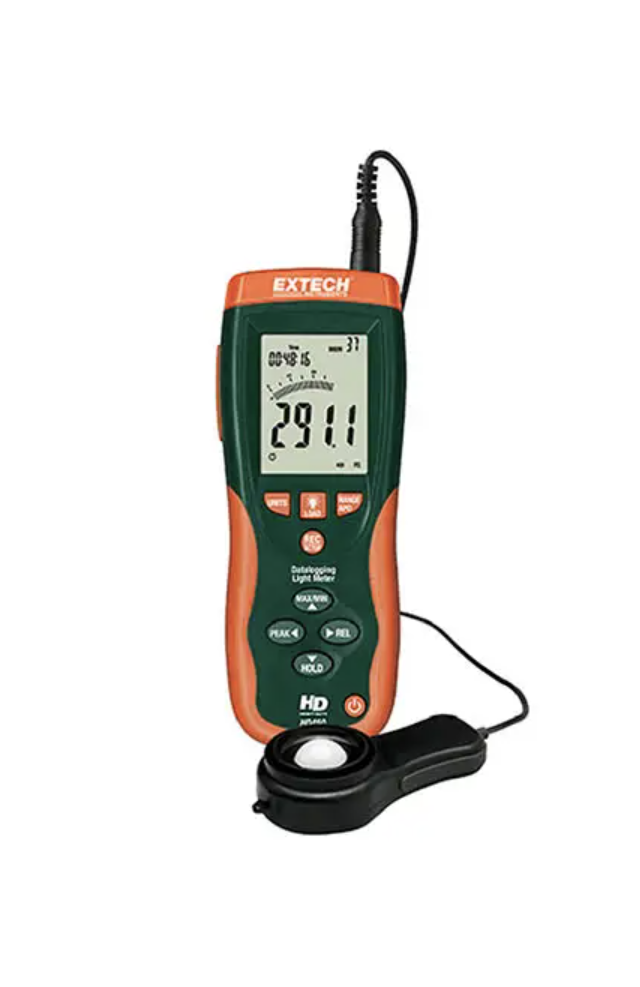
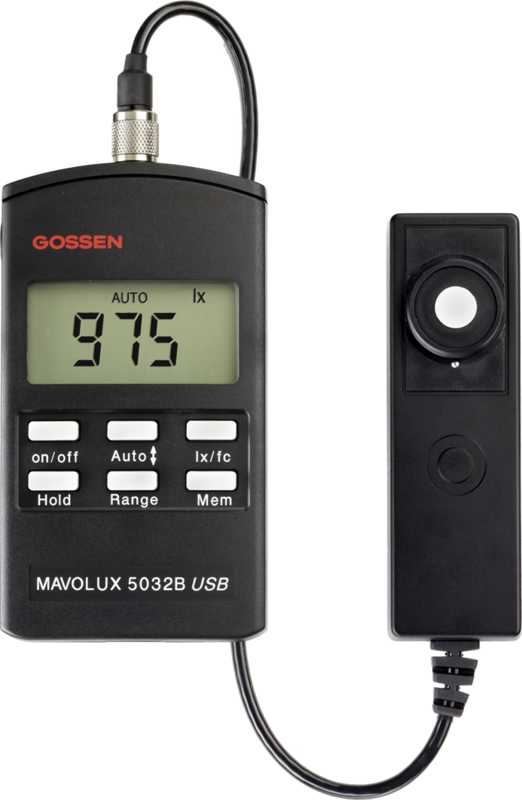
OSAT maintains several professional illuminance meters so the instrument can be selected for the measurement application. Current equipment includes the Konica Minolta T-10A, Extech HD450 and Gossen Mavolux.
Konica Minolta T-10A
Extech HD450
Gossen Mavolux
The Konica Minolta T-10A is a multi-function digital illuminance meter capable of measuring illuminance, illuminance difference and ratio, integrated illuminance and average illuminance. The Gossen Mavolux family provides precision illuminance measurements in lux or foot-candles with spectral response designed to correspond to the human eye’s photopic response.
Applications
Workplace and task-lighting surveys
Office, classroom and institutional lighting measurements
Industrial and manufacturing areas
Warehouses, mechanical rooms and support spaces
Parking, circulation and common areas
Pre- and post-upgrade lighting comparisons
Investigation of uneven or inadequate illumination
Measurement Against Project Criteria
Required or recommended illumination varies substantially with the task, occupancy and governing criteria. For that reason, reports can document measured values and compare them with the specific standard, specification, design criterion or client requirement identified for the project rather than relying on a single generalized table of recommended values.
Discuss a Lighting Survey
Contact On-Site Acoustic Testing with the facility type, areas to be evaluated and applicable lighting criteria, if known.