
Secure facilities · ICD-705 acoustic verification
SCIF, SAPF & VTC Acoustic Testing
Independent field testing for Sound Group 3 and Sound Group 4 requirements, from design review through acceptance, remediation, and retesting.
On-Site Acoustic Testing provides acoustic testing and consulting for SCIF, SAPF and VTC facilities from design review through construction, acceptance testing and remediation.
OSAT maintains cleared personnel capable of supporting work in secure and classified environments.
The applicable Intelligence Community technical criteria address many aspects of secure-facility construction. OSAT’s role is focused on acoustic protection and related field verification. Project requirements should be confirmed against the current governing criteria, approved construction documents and direction from the Authorizing Official (AO).
Sound Group 3 and Sound Group 4 Testing
The current publicly available IC Technical Specification identifies Sound Group 3 and Sound Group 4 acoustic-protection levels. For instrumented testing using Noise Isolation Class (NIC), the specification identifies NIC 40 for Sound Group 3 and NIC 45 for Sound Group 4.
Sound Group 3 is identified as the baseline for SCIF perimeter construction. Areas involving amplified conversations, including conference centers and VTC rooms, are identified for Sound Group 4 construction. The required level for a specific project should be taken from its approved security and construction requirements.
Field Acoustic Testing of Secure Facilities
Instrumented testing evaluates the installed condition rather than relying solely on the laboratory rating of individual construction materials. Walls, doors, windows, penetrations and other openings can create different transmission paths, so the measurement plan is developed around the actual secure perimeter and project requirements.
For additional background on the governing acoustic criteria, see our ICD-705 acoustic testing considerations.
Doors, Walls and Other Transmission Paths
Testing commonly includes perimeter walls, doors, windows, openings and other potential transmission paths identified by the project requirements. Where acoustic separation is also required between operations inside a secure area, those interior boundaries may require separate evaluation as well.
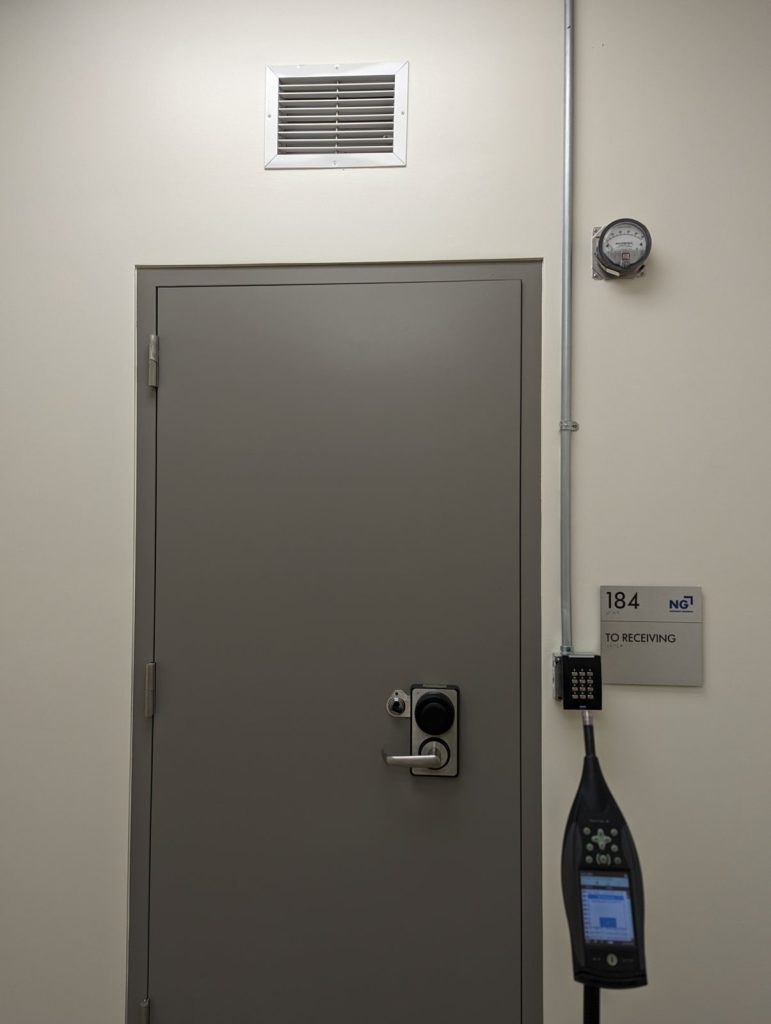
Doors, seals, penetrations, ductwork, utility pathways and construction junctions can control the measured result even when the primary wall construction is substantial. Testing and troubleshooting therefore focus on the installed assembly and the actual paths by which sound can leave the protected space.
Design Review, Remediation and Related Testing
OSAT can support secure-facility projects before final testing with acoustical plan review and acoustic modeling. When an installed partition does not achieve the required result, field measurements can help identify likely leakage and transmission paths and guide remediation and retesting.
Acoustic security is distinct from electromagnetic shielding performance. OSAT also provides RF shielding testing and field verification for projects requiring both disciplines.
Planning and Pricing Secure-Facility Testing
For project planning and pricing, provide a marked-up floor plan or an accurate count of the walls, doors and other partitions requiring testing, together with the applicable Sound Group and any project-specific requirements.
