
Infrared thermography provides a non-contact view of surface-temperature patterns that can support building-envelope, mechanical, electrical, equipment, process, and diagnostic investigations.
On-Site Acoustic Testing uses FLIR thermal imaging as a field-investigation tool where temperature distribution, thermal anomalies, or changes under different operating conditions may help identify a problem or document performance.
FLIR Thermal Imaging and Surface-Temperature Mapping
Thermal images can show temperature patterns that are difficult to identify with conventional visual inspection alone. Depending on the project, OSAT can document surface-temperature differences, anomalous hot or cold areas, equipment operating patterns, and changes observed before and after corrective work.
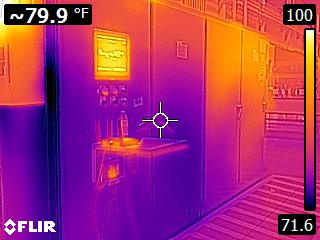
Mechanical, HVAC, and Equipment Investigations
Thermography can be useful when investigating HVAC systems, air handlers, pumps, fans, motors, piping, rooftop equipment, generators, cooling equipment, and other accessible machinery or process surfaces. Thermal patterns can be compared between components or operating conditions to help identify areas that warrant additional investigation.
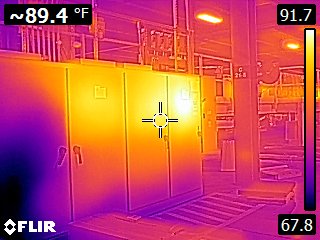
Building Envelope and Construction Investigations
Thermal imaging can identify temperature anomalies at walls, ceilings, windows, doors, penetrations, and other envelope or construction elements. These patterns may be associated with insulation discontinuities, air movement, thermal bridging, moisture-related conditions, or other construction differences, although interpretation depends on site conditions and should be correlated with other observations or measurements as appropriate.
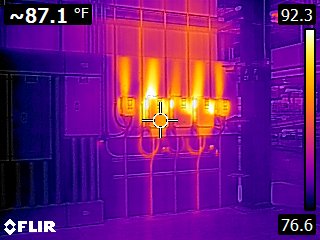
Electrical and Accessible Equipment Surfaces
Infrared imaging can document unusual temperature patterns at accessible electrical panels, connections, and equipment surfaces without physical contact. OSAT uses thermography as a screening and documentation tool rather than as a substitute for electrical inspection, electrical safety evaluation, or trade-specific diagnostic work.
Data Center Thermal Investigations
For data centers and other mission-critical facilities, FLIR imaging can supplement noise and vibration work by documenting surface-temperature patterns at cooling equipment, air-handling systems, electrical and mechanical equipment, and other accessible infrastructure. Testing can include operating-condition comparisons, anomalous hot or cold areas, and before-and-after documentation associated with troubleshooting or corrective work.
Before-and-After and Comparative Testing
Where conditions can be reproduced, thermal images can be collected before and after repairs, adjustments, mitigation, or operating changes. Comparative imaging can provide a useful visual record of how surface-temperature patterns changed under the documented conditions.
Thermography as Part of a Broader Investigation
Infrared thermography does not directly measure sound leakage, vibration, electrical integrity, airflow, or moisture. It is most useful when thermal observations are interpreted alongside the appropriate field measurements and site information. For acoustic investigations, thermal imaging can provide supplementary information about construction discontinuities, while sound leakage itself should be confirmed using appropriate acoustic measurement or source-localization methods.
Independent Field Documentation
Reports can incorporate selected thermal images, visible-light photographs where useful, measurement conditions, observed temperature patterns, and technical interpretation appropriate to the scope of the investigation.
FLIR E8 Field Equipment
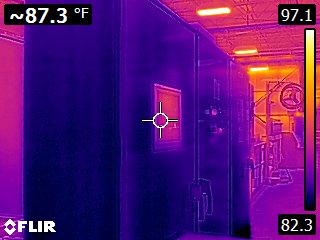
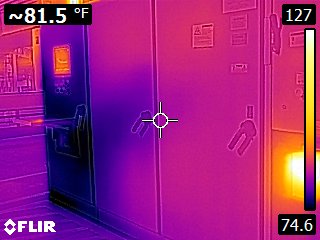
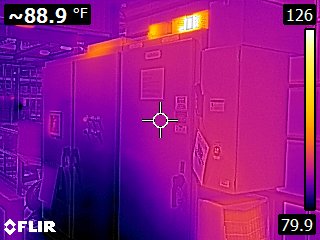
OSAT maintains FLIR E8 thermal imaging cameras for field investigations. These instruments help document relative temperature differences and conditions at the time of inspection. The following selected thermal images were captured using OSAT’s FLIR E8 equipment.
Selected FLIR Thermal Images
Examples from OSAT’s existing FLIR image archive. The colors show the selected display palette and relative thermal patterns; interpretation requires appropriate measurement settings and site context.
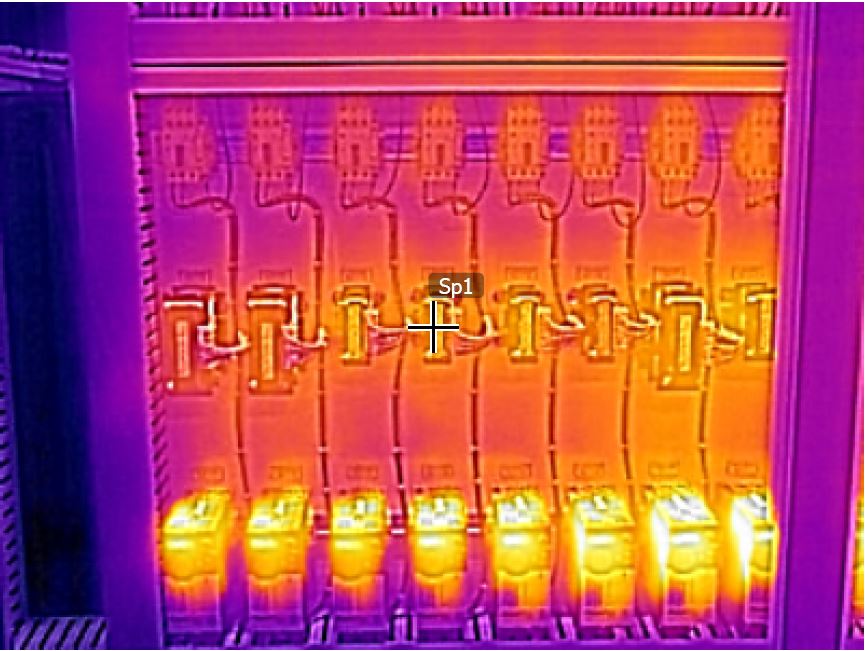
Measurement Conditions and Limitations
Thermal imaging measures emitted infrared radiation and estimates apparent surface temperature. Meaningful quantitative interpretation depends on emissivity, reflected apparent temperature, distance, viewing angle, environmental conditions, and instrument settings. A thermal anomaly is a diagnostic indication, not by itself proof of an electrical defect, moisture intrusion, or structural failure. Where a conclusion requires it, findings should be checked against additional observations, instruments, or specialist inspection.
For electrical work, inspections must be arranged with appropriate facility access, operating conditions, and qualified electrical personnel where required. OSAT’s thermography service is not a substitute for electrical safety assessment, code inspection, or a certified building energy audit unless expressly included in the agreed scope.
Integrated Investigations
Thermography can be combined with sound-level, sound-intensity, and vibration measurements when a facility has multiple interacting issues. For investigations involving mechanical source localization or other diagnostic methods, see Specialized Noise Testing and Source Localization. For cooling systems, equipment rooms, and facility operations, see Data Center Noise, Vibration & Thermal Testing.
What Clients Receive
Depending on the assignment, OSAT’s documentation may include representative thermal images, measurement locations, equipment and operating conditions, apparent temperature observations, image annotations, comparison of locations or operating states, and recommendations for further investigation where findings are inconclusive.
Discuss a Thermographic Investigation
Provide the building or equipment type, suspected condition, operating state, project location, and intended use of the results.