
On-Site Acoustic Testing (OSAT USA) provides independent noise monitoring services nationwide for contractors, industrial facilities, utilities, data centers, commercial property owners, developers, municipalities and legal teams. We measure sound levels over the periods that matter to a project, from targeted operating cycles to continuous multi-day deployments, and provide documented measurement results with technical interpretation.
Request a noise monitoring proposal · View our project experience
For short-duration measurements or targeted diagnostic work, see our independent noise testing services.
Environmental, construction and industrial noise monitoring services
Independent noise monitoring services document changes over time, including intermittent sources, production cycles and overnight conditions. For an investigation requiring a shorter survey or source diagnosis, see noise survey services; for technical review and interpretation beyond the monitoring scope, see acoustical consultants.
A single sound level reading tells you what happened at one moment. A properly designed monitoring program establishes how sound levels vary over time, when significant events occur and how measured conditions relate to the project criteria.
- Construction noise monitoring: preconstruction baseline measurements, documentation of active work periods and assessment against applicable project or ordinance criteria.
- Environmental and community noise monitoring: daytime and nighttime sound levels, property boundaries, nearby receptors and recurring sound events.
- Industrial and equipment noise monitoring: machinery operating cycles, HVAC equipment, cooling systems, substations and other facility sources.
- Data center noise monitoring: documentation of cooling equipment, generator operating periods and changing facility loads where relevant to the measurement scope.
- Commercial property and development monitoring: baseline sound conditions for proposed buildings, occupied spaces and post-remediation verification.
- Independent technical documentation: measurement histories and supporting records for project teams and attorneys requiring defensible field data.
When the objective is to evaluate measured sound against project criteria at defined receiver locations, see our environmental noise assessment services.
What does a noise monitoring program measure?
Instrumentation, microphone positions, measurement intervals, frequency weighting and averaging periods are selected to suit the applicable criteria. Depending on the scope, measurements can include:
| Measurement | Application |
|---|---|
| LAeq,T | Energy-equivalent A-weighted sound level over a defined period. |
| LAFmax | Maximum A-weighted sound level using Fast time weighting, when specified. |
| Statistical levels (L10, L50, L90) | Sound levels exceeded for defined percentages of the measurement period. |
| Octave-band and one-third-octave-band levels | Frequency-dependent assessment of mechanical, tonal or low-frequency sound where appropriate. |
| Time history and event records | Comparison of measured conditions with operating schedules, construction activity or reported events. |
There is no single universal permissible environmental noise level. A local ordinance, permit, contract specification or agreed assessment criterion may require different measurement procedures and limits.
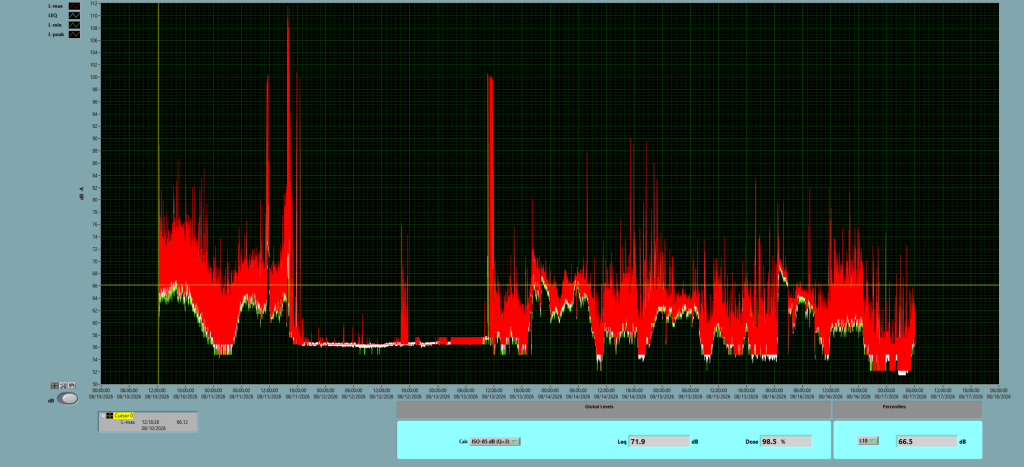
Attended, unattended and remote noise monitoring
Attended measurements allow a technician to document sound sources and operating conditions directly. Unattended monitoring captures extended periods when continuous staffing is unnecessary. On suitable projects, remote data review over Wi-Fi or cellular connectivity and configurable threshold notification emails can support timely review. Time-stamped audio can be included where appropriate and authorized. Remote connectivity and alerting depend on site conditions, power and communications availability.
For extended deployments, combined sound and vibration measurements and remote monitoring configurations, see our long-term noise and vibration monitoring services.
How OSAT structures a monitoring assignment
- Define the objective: identify the activity, receptors, relevant limits and reporting requirements.
- Establish the measurement plan: select representative locations, monitoring periods and instrumentation; document site conditions and instrument setup.
- Collect and review data: record sound levels and relevant events, review data quality and consider environmental or operating influences.
- Evaluate and report: summarize results, compare them against agreed criteria where applicable, and describe limitations and significant events.
- Verify changes: conduct follow-up measurements when corrective measures or changes to equipment operation need to be evaluated.
Selected noise monitoring project experience
Representative assignments from OSAT’s published project portfolio include:
- Roseville Electric Utility: spot and logged environmental noise measurements around a utility facility.
- ASM Assembly Systems: monitoring of noise and vibration associated with a nearby railroad at an industrial property.
- Hampton Inn & Suites — Belgrade, Montana: preconstruction baseline noise survey and monitoring.
- Lehigh Valley Hospital — Hazleton, Pennsylvania: extended noise-level monitoring.
- DLH Development — Destin, Florida: environmental noise survey and monitoring.
See the full project experience portfolio. Project references describe assignments rather than endorsements or necessarily direct contractual relationships.
Independent reports, not simply equipment rental
OSAT’s service includes measurement planning, field instrumentation, data collection and technical reporting. Depending on the scope, deliverables include time-history plots, statistical summaries, frequency data, documented measurement locations, operating conditions, instrument information and comparisons with applicable criteria. See our reports and deliverables and environmental noise surveys and consulting services.
Frequently asked questions
How long should noise be monitored?
The appropriate duration depends on the operating cycles, event frequency, applicable evaluation periods and purpose of the assessment. A short attended survey may be sufficient for a stable source; intermittent or variable conditions may require days or longer.
Can you measure noise at a property boundary?
Yes. The measurement plan identifies the applicable locations, receptors, operating conditions and criteria. A property boundary is not necessarily the only location required by a particular ordinance or specification.
Can noise monitoring distinguish one source from another?
Time histories, spectral data, attended observations and authorized audio records can help identify events. Where source attribution requires further investigation, OSAT can scope specialized source localization and noise testing.
Can you monitor employee exposure?
Personal occupational noise exposure is a separate measurement objective from stationary environmental monitoring. See our noise dosimetry services.
Request a noise monitoring proposal
Tell us the facility location, activity or equipment, anticipated monitoring period, evaluation criteria and reporting needs. OSAT provides nationwide field testing; see our service areas.